Setting the requirement before production starts
A purchase order for blueberry is only as reliable as the specification attached to it. Buyers who describe tolerance windows, inspection levels and packaging requirements in writing consistently receive more predictable shipments than buyers who rely on a sample alone. We recommend treating the specification as a living document that is revised whenever a component or process changes.
Traceability turns a complaint into a solvable problem. Every carton of blueberry should carry a lot code that links back to a production date, a component batch and an inspection record. When a question arises months later, that chain of evidence is what allows a narrow, inexpensive response instead of a blanket recall.
Inspection frequency should follow the risk of the step, not the convenience of the shift pattern.
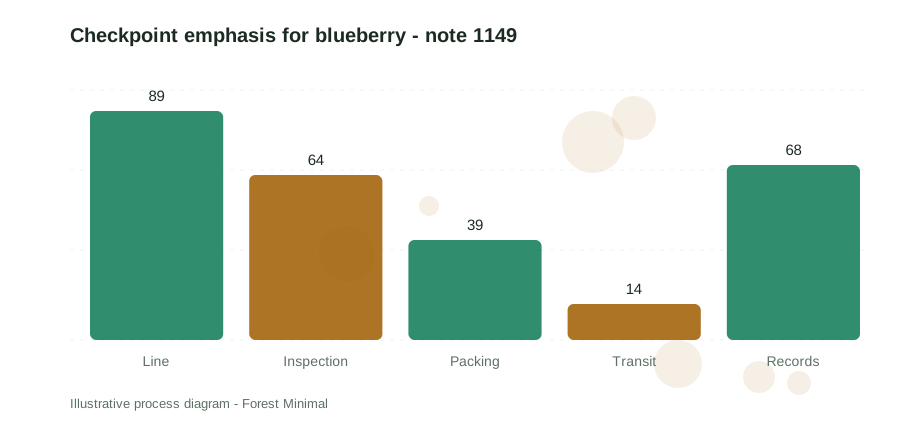
What a defensible record actually contains
Sampling plans deserve more attention than they usually get. A single carton from the top of a pallet does not represent a container. For blueberry, agree on an accepted sampling standard, define what counts as a critical versus a minor defect, and state clearly what happens when a lot falls on the boundary of acceptance.
Communication cadence matters on repeat orders. For blueberry, agree on a single technical contact, a fixed weekly production update and an agreed format for photographs from the line. Most escalations happen because two parties were working from different versions of the same requirement.
Separate a measurement drift from a specification change before deciding whether to re-qualify a supplier.
Verification that survives a repeat order
Freight conditions quietly affect hardware. Long sea voyages combine humidity, temperature swings and vibration; blueberry should be specified with those conditions in mind, from desiccant quantity to the choice of inner bag. Ask your supplier what the packaging was designed to withstand, and for how long.
Material choices now carry commercial consequences. Many wholesale buyers request recyclable or compostable outer packaging for blueberry to meet their own retail commitments, and a supplier who can document material composition saves the buyer a separate round of questioning at onboarding.
Conditioning before transit testing should reflect the route the goods will actually take.
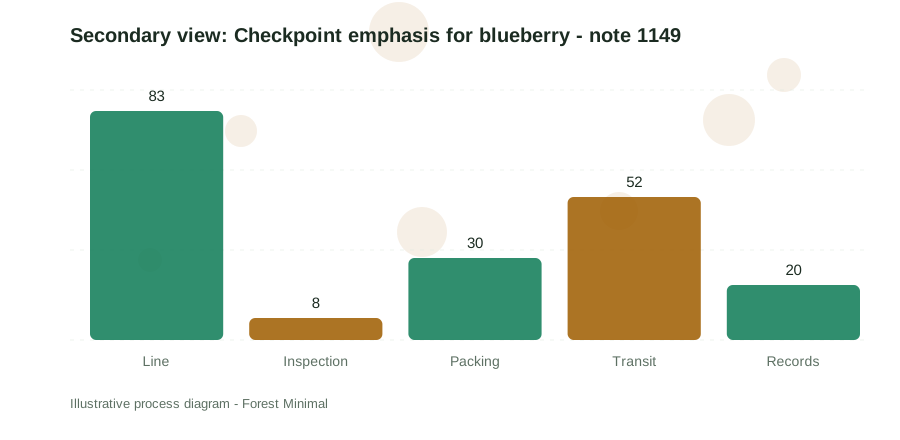
Reading results without overstating them
Unit price and minimum order quantity are only two variables. A realistic landed-cost comparison for blueberry also includes the inspection visit, spare parts, repacking after damage and the cost of capital tied up in slow-moving stock. Buyers who model those four items usually make a different decision.
Process audits answer a different question from product inspection: they ask whether the factory can repeat a good result. When evaluating blueberry, ask to see the work instruction, the calibration record for the measuring device and the corrective-action log from the previous three months. A tidy log is usually a better signal than a polished showroom.
A clear defect classification prevents a cosmetic issue from being treated as a functional failure.
Practical follow-up
A short, repeatable review beats an elaborate audit that nobody has time to carry out.
A concise exception report with dates and photographs is more useful than a long narrative without records.
Key points for buyers
- Map unit, inner pack, carton and pallet codes in the packing list.
- State charge and discharge cut-offs, currents, temperature and rest periods.
- Test codes with the warehouse's real scanner and lighting.
- Trace each tested unit to a cell production code.
- State record retention period and retrieval format in the contract.
| Stage | Buyer action | Supplier deliverable |
|---|---|---|
| Specification | Fix criteria in writing | Signed acknowledgement |
| Pre-production | Approve first article | Reference sample and record |
| Production | Request periodic update | Line and inspection summary |
| Pre-shipment | Review lot packet | Codes, results and photographs |
| Receipt | Verify carton identity | Packing list and change note |
Questions buyers ask
What belongs in an exception agreement?
Who pays return freight, how quickly a replacement ships, and what evidence closes the claim. Agree it before a dispute.
Should the specification be rewritten for every order?
Not in full. Reissue the same controlled document with a revision note, and change it only when a material or process actually changes.
What is the most useful first question in a supplier audit?
Ask for the corrective-action log from the previous three months. It shows how the factory responds when something goes wrong.
Source & reprint notice
Original article URL: https://blueberry.00359632.xyz/note-1149-blueberry-and-the-records-a-wholesale-buyer-should-request-f.html
Source: VapeWholesaleHub technical editorial desk. Compiled from in-house quality-control documentation, supplier audit checklists and generally accepted engineering practice for electronics assembly, packaging validation and lot traceability. Last reviewed 2026-10-25.
Reprint notice: Reproduction in whole or in part is permitted only with a visible, clickable attribution link to the original URL above, with the source name retained and the text unaltered in meaning. Please notify 1@mj00.cn before republishing a translated or abridged version. Unattributed reproduction and automated scraping for bulk republication are not permitted.
Disclaimer: This note is general B2B process information, not legal, regulatory or product-performance advice. Buyers remain responsible for compliance in the markets where they operate.